Category Archives: Travellers’ Tips

What a talk in the bookshop taught me about life and travel

Last week I went to a talk in the bookshop*, on the topic of travel writing. Notebook open, pen poised, I sat in the second row (near enough to hear in case the speaker had a soft voice, far enough to escape being picked on to answer awkward questions). I looked around at the rest of the group, curious to see who else shares the twin passions of travel and writing. A diverse bunch, it seems. The vibrant young American woman of Pakistani heritage, who lives in New Mexico and teaches literacy and wore wonderful elephant earrings. A couple of sociology professors. An Irishwoman with an encyclopaedic knowledge of travel literature, several books under her belt, arthritic fingers, and wisps of white hair escaping from under her Che Guevara style cap.

So, did I learn much about travel writing? Yes, I learnt a lot – about genre, technique, pitching, practical tips about organising my time. But here’s the thing. I learned some lessons about life, too. Echoes of things I’ve learned while travelling, too. So here they are, in no particular order:

Find your niche – maybe it’s food, maybe history or literature, maybe trains (like ‘the man in seat 61’).

Prioritise your passions. If you want to achieve something, make time and space in your life for it. Regularly. And starting now.

Take notice and take notes.

You’ll meet all sorts of people along the way. They all have a story, they all know something you don’t know. Most of them want to share it. Talk to them.

You’ll be exhausted sometimes, bored, uncomfortable. It doesn’t matter. It will pass. It goes with the territory.

And last, but not least – yes, you might worry about failing or being embarrassed. Yes, you might make mistakes. You never know until you try, more often than not the rewards are worth the risk. So go ahead and do it.

* The bookshop? Blackwells in Oxford, England. The best bookshop in the world. The speaker? The inimitable Jonathan Lorie, travel writer and teacher, who imparts his expertise with humour and generosity, and who has just published an essential book for anyone interested in travel and writing, ‘The Travel Writer’s Way”.

When in Japan…

Travelling Frogs try* wherever they go to respect the culture and behaviours of the places they visit. Often though it’s not really clear what to do, or what not to do. So the Frogs welcome initiatives like this one, from one of Japan’s most popular tourist destinations.

*with varying success, I suspect, despite the best of intentions

Tips about Tips

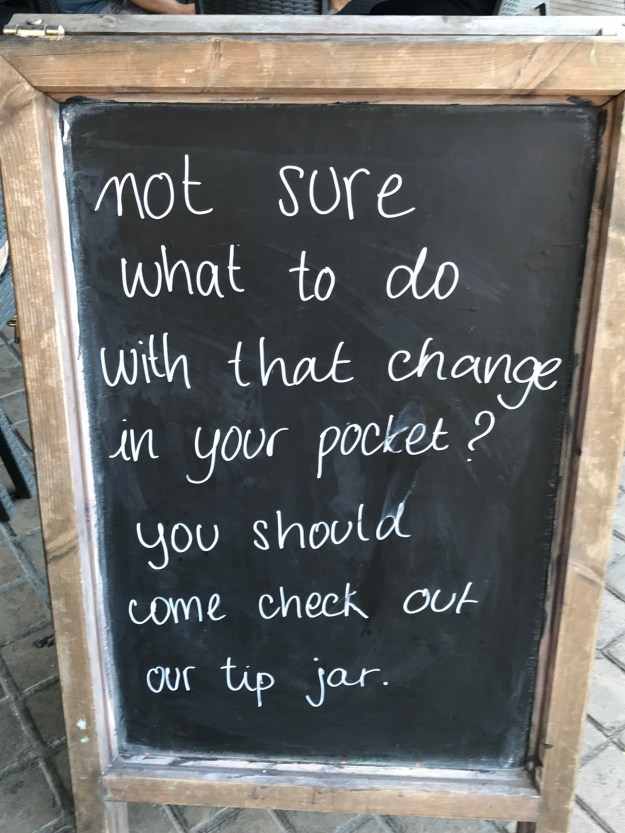
Seen recently in Bordeaux, this notice made us smile. It also made us think.
img_6211


One lesson from travelling – we learn a lot, including how much we don’t know. All those unwritten ‘rules’ around the world; what to wear, how to greet people, what time to eat etc etc. Some things you can work out – as the late great Yogi Berra said “you can observe a lot by just watching” – others are more tricky. One of the tricky ones is tipping. Have you ever wondered (we have!) should I tip or shouldn’t I? How much? Who should I tip?

Countries that appear similar in many ways can have different tipping cultures. In the Netherlands tips are expected in restaurants, in Belgium they’re not. The French, British and Americans tip the hairdresser, the Dutch and Swedish don’t. In the US tipping is almost obligatory, and amounts are higher than in Europe too. I guess we’re not the only ones who routinely research “tipping in ….” before we go.

Because there’s that worry, isn’t there, what if we get it wrong? Tipping when we shouldn’t, for example. Well, in Japan your offering might be turned down, tipping is considered rude. And although things might be changing a bit in Australia in the cities, one Australian* maintains “… many of us hate it when people tip. It is not necessary and a culture that we do NOT want in Australia”. If even if tipping is OK, though, how much is the right amount? The “accepted” sum can vary, from loose change, up to 20-25%.  Rick Steves (ricksteves.com) advises Americans travelling in Europe “…if your bucks talk at home, muzzle them on your travels” and goes on to say “believe me – tipping 15 or 20 percent in Europe is unnecessary, if not culturally ignorant”. Oh dear.

Rick’s comments hint at another aspect of the tipping dilemma, what does our tipping (or lack of) say about us? what will others think about us based on the way we tip? Or even on the way they expect us to tip? This was really brought home to me when I recently read an insightful and thought provoking post “Tipping While Black – Dismantling Stereotypes in the US and Abroad” (theblogabroad.com). Well worth reading, well worth thinking about, whatever our skin colour. And an addition to the big debates about tipping and “overtipping”, especially by travellers from richer countries in poorer places, debates about many of the big questions of our times: inequality, the world order, best ways to relieve poverty, and so on, and on…


*taken from TripAdvisor, 2016


A Few Packing Tips

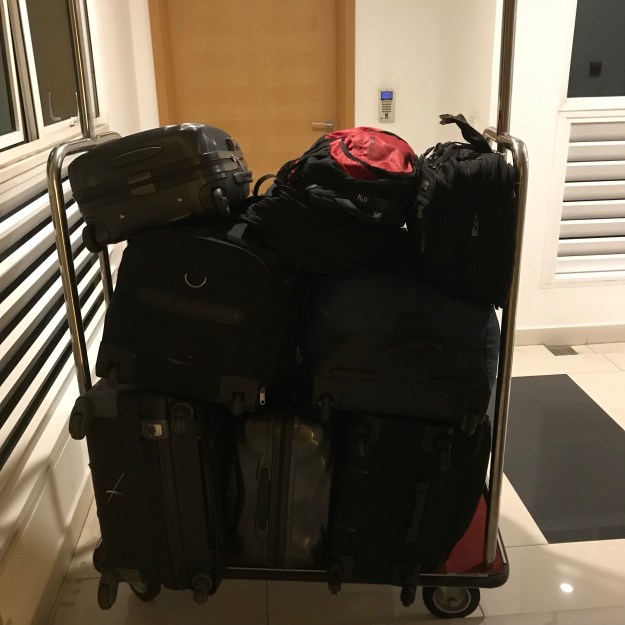
Ok, I’ll admit it. This is a LOT of luggage. (In our own defence, it was what we brought home after two years in Asia). But still…Seeing, not to mention transporting, this amount of stuff did make me think. How in future could we travel a bit, well, lighter. A recent article* provided food for thought..

One suggestion was to follow the advice of Jerome K Jerome’s narrator in his classic book Three men in a Boat: “It is lumber, man- all lumber! Throw it overboard”. Hm, I admire the principle, just I’m not sure it would work for me. Lumber? All of it? My book, my diary, phone? Even my sun hat? A scarf? An extra pair (or two) of shoes? Splish splosh never to be seen again? No, don’t think that’s for me,

Maybe a better strategy is to think about what to take, rather than what not to take. So the advice novelist Louisa Young received from her sister would Be helpful. This intrepid lady, who went round the world on a motorbike and presumably knows a thing or two about packing, recommends taking “one silk dress – rolls up tiny, in case an Ambassador invites you for tea”. There’s that idea about making things you pack work for their keep, too – international educationalist Thom Jones always takes a harmonica, and uses it to judge the countries he goes to by whether their customs staff demand that he plays it…

But the best advice of all, I think, was given to writer Horatio Clare in the Kaokoveld Desert. Clare asked: “What should I take?” His Namibian guide replied: “Go with a level head and a humble heart. You’ll be fine”. You know, I think that’s one to try. It might even work if (when?) that  Ambassador invites us for tea…

* Horatio Clare’s article on packing, The Observer magazine, 29 July 2018