I love this tweet, forwarded to me by a friend….

I love this tweet, forwarded to me by a friend….

Eva, a Hungarian friend, was trying to decide how she should respond to an ex-boyfriend who wanted to rekindle their relationship.
So she turned to her Grandma, who provided the answer to the dilemma: “The only thing that’s good reheated is stuffed cabbage”.
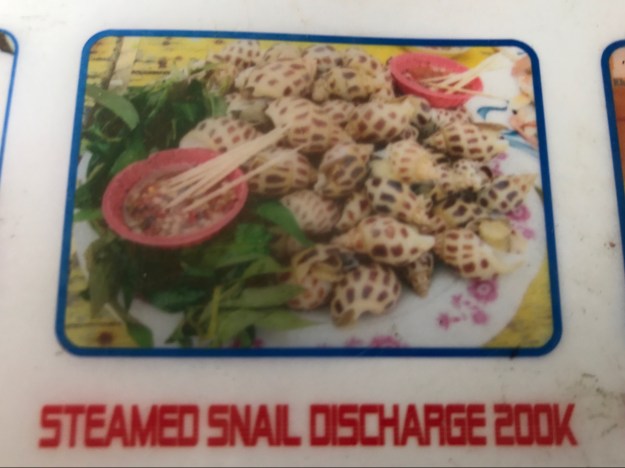
Now, Travelling Frogs consider themselves reasonably intrepid, and like to try interesting foods wherever they go. However, this dish (on the menu in Danang, Vietnam) gave us food for thought*. Had something, somehow, got lost in translation? Should we try it anyway, in the interests of research and appreciating local culture?
I’m sorry to say (am I really sorry?) that, on this occasion, courage forsook us. Maybe another time…
*sorry!


Some are raw (Rohwurst), some are grilled (Kochwurst), some are boiled (Brühwurst). Some are named after an ingredient: Bierwurst (beer), Fleischwurst (meat), Blutwurst (blood), Currywurst. Some are named after places – Frankfurter, Regensburger. Some are named after the people who (presumably) ate a lot of them – Zigeuner (gypsy) or Landjäger (hunter). A lot of them are regional specialities – Weisswurst, (white sausage. So named because it is, er, white) is a speciality of Bavaria. It’s hardly eaten in Northern Germany, so its consumption marks a symbolic North/South divide, the Weisswurstäquator (white sausage equator). And there’s even a museum dedicated to a sausage. The German Currywurst Museum in Berlin was opened on the 60th birthday of the invention of this staple, first made by one of the women who worked to clear the rubble in Berlin after World War II. She added whatever she could find, including curry powder and tomato paste, into the mixture to make it tasty. 800 million Currywurst are sold in Germany every year.
What’s not so clear (to me, anyway) is why ‘Das ist mir Wurst’ (literally ‘it’s a sausage to me’) means ‘it’s all the same to me’. Or how ‘Es geht um die Wurst’ (‘it’s about the sausage’) came to mean ‘it’s do or die’/’now or never’/’the moment of truth’.
I guess many of us have heard this health tip:
“Breakfast like a king, lunch like a prince, and dine like a pauper”.
I’ve seen it in the UK and the US, heard something similar in India, in France and in Hungary.
A friend from Bratislava told me the Slovak version:
“Breakfast like a king, lunch like a prince… and give your dinner to your enemy.”
Ahhh.
Invited to Russia, composer Giuseppe Verdi was convinced he wouldn’t enjoy the food. So he did the obvious thing – reserved two railway carriages for the trip. One for accommodating him and his wife, and the second for supplies: hams, eggs, Parmigiano Reggio, Italian breads and flour… Then there was the problem of what to drink. French wines were the great man’s favourite, so a third carriage was stocked in Lyons and sent to Berlin where the Verdis waited for it. The whole entourage then proceeded to St Petersburg, where they presumably ate and drank to their satisfaction for the whole of their trip.
 travelling frogs