According to this sign (in Nafplion, Greece), if you want to have a lovely day: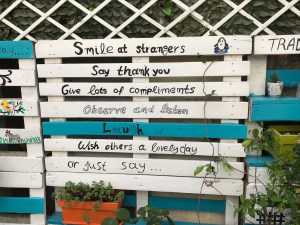
Complete this list…
Leave a reply
According to this sign (in Nafplion, Greece), if you want to have a lovely day:
“If we all pulled in one direction, the world would keel over”
(Yiddish Proverb)
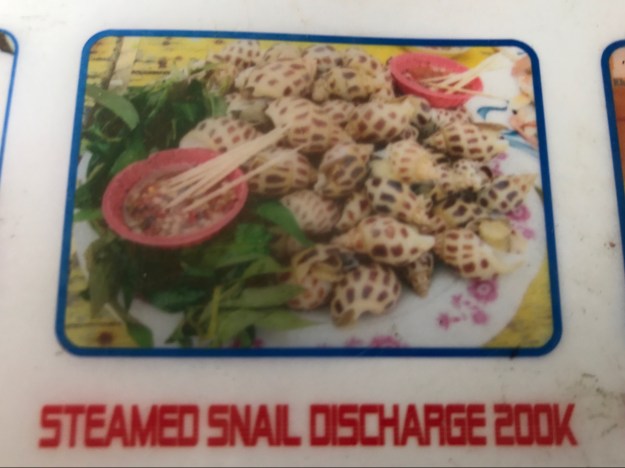
Now, Travelling Frogs consider themselves reasonably intrepid, and like to try interesting foods wherever they go. However, this dish (on the menu in Danang, Vietnam) gave us food for thought*. Had something, somehow, got lost in translation? Should we try it anyway, in the interests of research and appreciating local culture?
I’m sorry to say (am I really sorry?) that, on this occasion, courage forsook us. Maybe another time…
*sorry!
Travelling Frogs are in France at the moment, and today the ‘cloches volutes’, the flying bells, have come back!
In the local tradition, church bells don’t ring between Good Friday and Easter Sunday. Instead they fly to the Vatican to be blessed by the Pope, and come back on Saturday night, loaded with presents (yes, you guessed it, mainly chocolate!) ready to peal joyously on Easter Sunday. And when the bells ring, or when someone calls ‘les cloches sort passees’, that’s the signal for the start of the Easter egg hunt…
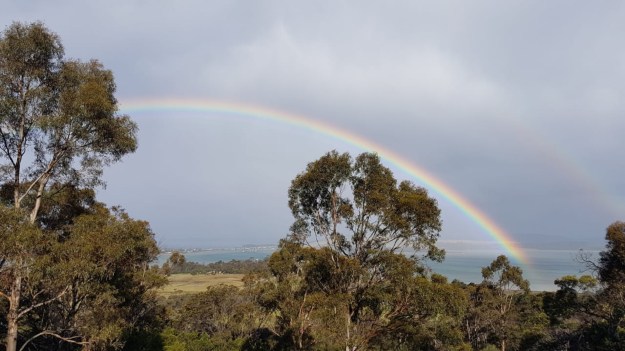
…is the name of one of the late, great Terry Pratchett’s books, in which he asks “Why do you go away?” I love his answer: “So that you can come back. So that you can see the place you came from with new eyes and extra colors. And the people there see you differently, too. Coming back to where you started is not the same as never leaving.”
Marcel Proust said the same thing, I guess: “The real voyage of discovery consists not in seeking new landscapes, but in having new eyes.”
Food for thought, isn’t it…
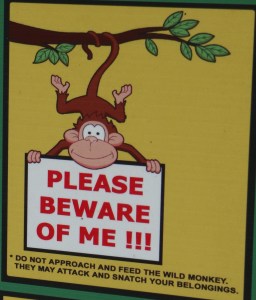
We were told in Malaysia that monkeys fed by tourists are starting to suffer from obesity and diabetes – too much of the wrong food (and presumably, because they don’t have to search for it themselves, not enough exercise…)
And if that’s not enough to deter us, our guide explained that, in monkey communities, the alpha male is given food by inferiors. So they immediately rank anyone who feeds them as inferior and might treat them aggressively.
Ok, I’m convinced!


Some are raw (Rohwurst), some are grilled (Kochwurst), some are boiled (Brühwurst). Some are named after an ingredient: Bierwurst (beer), Fleischwurst (meat), Blutwurst (blood), Currywurst. Some are named after places – Frankfurter, Regensburger. Some are named after the people who (presumably) ate a lot of them – Zigeuner (gypsy) or Landjäger (hunter). A lot of them are regional specialities – Weisswurst, (white sausage. So named because it is, er, white) is a speciality of Bavaria. It’s hardly eaten in Northern Germany, so its consumption marks a symbolic North/South divide, the Weisswurstäquator (white sausage equator). And there’s even a museum dedicated to a sausage. The German Currywurst Museum in Berlin was opened on the 60th birthday of the invention of this staple, first made by one of the women who worked to clear the rubble in Berlin after World War II. She added whatever she could find, including curry powder and tomato paste, into the mixture to make it tasty. 800 million Currywurst are sold in Germany every year.
What’s not so clear (to me, anyway) is why ‘Das ist mir Wurst’ (literally ‘it’s a sausage to me’) means ‘it’s all the same to me’. Or how ‘Es geht um die Wurst’ (‘it’s about the sausage’) came to mean ‘it’s do or die’/’now or never’/’the moment of truth’.
Lots of languages have words with no direct counterpart in English. Dutch for example has a word for skimming stones (it’s ‘plimpplamppletteren’, in case you need it). Indonesians have a word meaning ‘to take off your clothes in order to dance’. A Japanese word which might be rather useful is ‘age-otori’, which means ‘looking less attractive after a haircut’. (On second thoughts though, such honesty might not be very diplomatic).
The Finns, all 5.56 million of them at the last count, have lots of words for specifically Finnish concepts. Even better than that, they’ve also designed emojis for many of them. Here are some of my favourites…


You might get the feeling of PRKL. If you do decide to use ‘perkele’, the mother of all Finnish swearwords (literally ‘the devil’ but means much more than that), say it like you mean it! You can make the curse longer and more effective by rolling the ‘r’. You might experience the feeling of banging your head, too. (Finns do, a lot – heavy metal is mainstream, and there are more heavy metal bands in Finland per capita than anywhere else. Who knew?)


So, if any Finns happen to be reading Travelling Frogs blog, thanks for the insights into your country, and for the emojis! Not to mention the permission to download* (for non-commercial use) all 56 of them
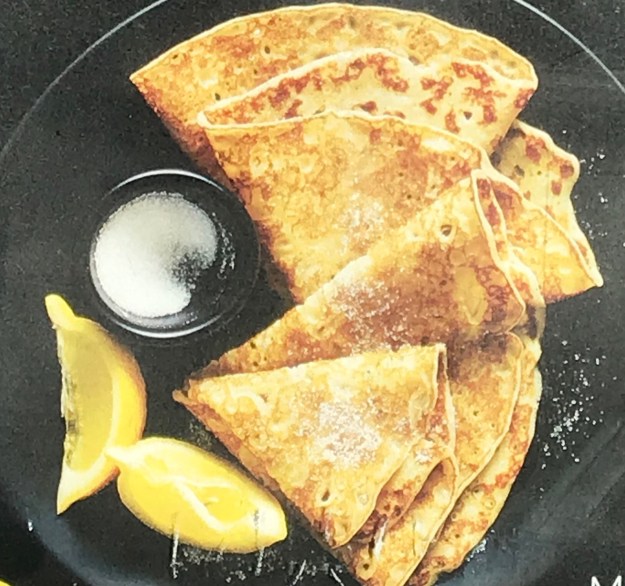
5 March is the date of Shrove Tuesday this year. The fasting season of Lent starts the following day, so traditionally this was the day when milk, sugar, eggs and the like were used up to clear the way for 40 days of more abstemious fare. And what can you make with milk, sugar and eggs? Pancakes, of course!
And it’s not a uniquely British tradition, Pancake Day is marked in countries from the US to Ukraine and Russia.
Indeed, Travelling Frogs saw a range of options on a Moscow restaurant menu:
My mummy’s pancakes (with butter)
My mother in law’s pancakes (with sour cream)
My wife’s pancakes (with honey)
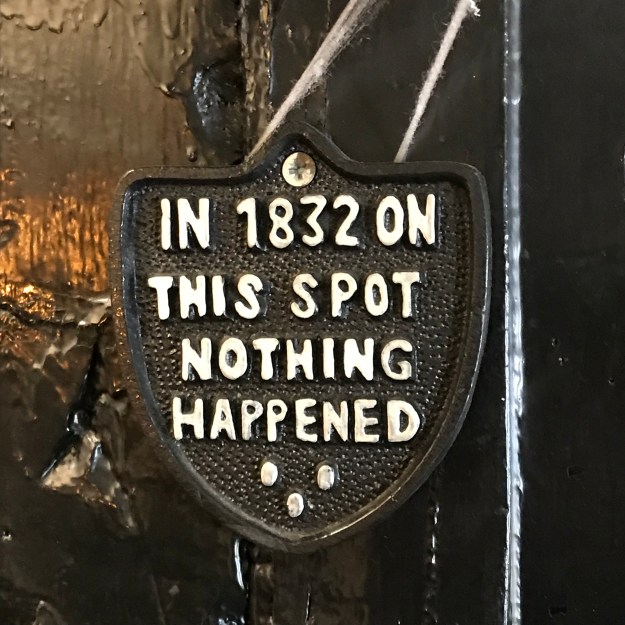
Travelling Frogs saw this sign in the pub at Snatchems*, on the banks of the River Lune in Lancashire, England.
 travelling frogs